
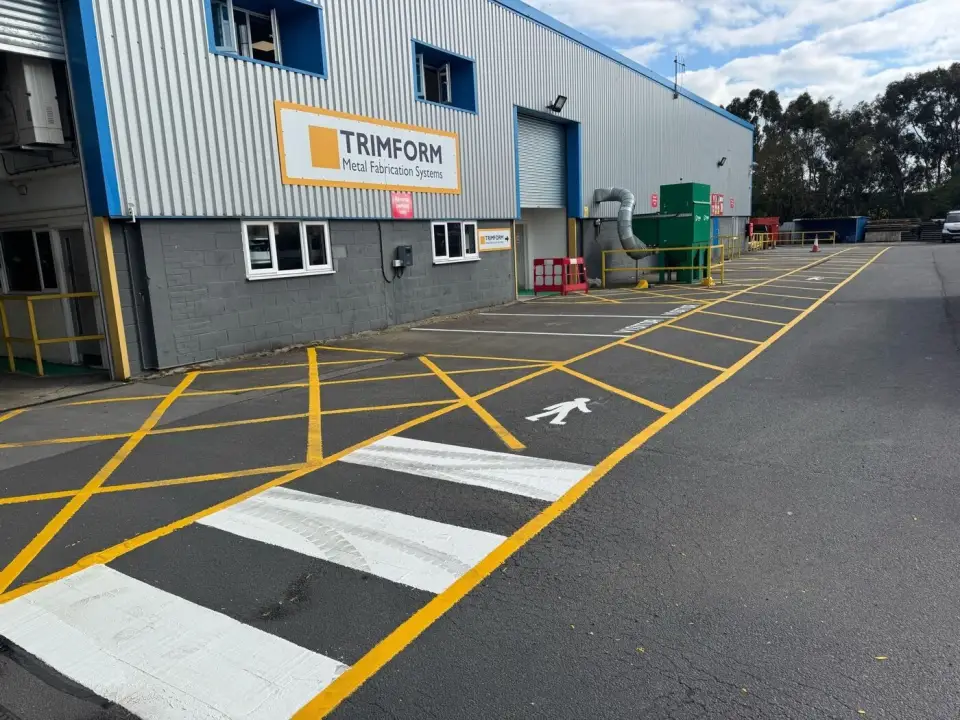
Internal and external line marking might look like the same job, but the two face very different conditions, and those conditions decide which materials work, how long the markings last, and what preparation is needed.
It is a question that comes up more than you would expect, usually when someone is specifying works that cover both indoor and outdoor areas on the same site.
Can we just use the same system inside and out?
Sometimes, but not always. Using the wrong system for the environment is one of the quickest ways to end up with markings that underperform.
The key differences in environment.
The most obvious difference is weather exposure, but it goes further than that.
External markings deal with:
- Rain, frost, snow, and standing water
- UV exposure from direct sunlight
- Temperature extremes and thermal cycling
- Road salt and grit during the winter months
- Vehicle traffic, including heavy loads on asphalt surfaces
- Contamination from fuel, oil, and tyre rubber
Internal markings deal with:
- Controlled or semi-controlled temperatures
- No direct weather exposure, though some environments have moisture issues
- Concrete or resin floors rather than asphalt
- Forklift and MHE traffic with tight turning movements
- Chemical exposure from cleaning agents, oils, and industrial processes
- Scuffing and abrasion from constant foot and vehicle traffic in concentrated areas
The demands are different, and the marking systems need to be selected accordingly.
Material differences.
This is where the practical impact shows up. Not every material works in every environment.
Standard road marking paint is commonly used externally on car parks and access roads. It is cost-effective and quick to apply, but it wears faster than other systems and needs reapplying more often, particularly in high-traffic areas or harsh weather.
Thermoplastic is primarily an external system. It is applied hot and bonds well to asphalt, it is durable, it is retroreflective when glass beads are added, and it handles vehicle traffic well. It is not typically used on internal concrete floors, though, because the high application temperatures are not always practical or safe indoors, and the material can be too rigid for smooth concrete.
MMA systems work well in both internal and external environments. They cure through a chemical reaction rather than evaporation, which makes them less dependent on temperature and weather. They are fast-curing, durable, and available in a wide range of colours. The main limitation is the strong fumes during application, which need managing in enclosed spaces.
Epoxy and resin systems are primarily internal products. They bond excellently to prepared concrete and offer strong chemical and abrasion resistance. Most are UV-sensitive, though, and will yellow and chalk if exposed to sunlight, which rules them out externally unless they are protected by a UV-stable topcoat.
Polyurethane systems can work in both environments. They are UV-stable, flexible, and abrasion-resistant. They are more commonly used internally, but they also suit external applications, where their flexibility helps accommodate thermal movement in the substrate.
The right material for each area depends on the surface type, the traffic, the exposure, and the performance required. Using an internal system externally, or the other way round, is where problems start.
Surface preparation differences.
The preparation requirements for internal and external line marking overlap in some areas and differ in others.
External surfaces are typically asphalt or concrete, and may need:
- Cleaning to remove dirt, moss, algae, and general surface contamination
- Degreasing in areas with oil or fuel spillage
- Drying time after rain before marking can proceed
- Patch repair of potholes or surface damage
- Shot blasting or mechanical preparation where old coatings need removing
Internal surfaces are usually concrete, power-floated concrete, or existing coated floors, and may need:
- Removal of laitance on new concrete
- Shot blasting or diamond grinding to create a surface profile
- Degreasing to remove oil, chemical, or rubber contamination
- Removal of existing coatings that are failing
- Moisture testing to confirm the slab is dry enough for coating
The principle is the same in both cases: the surface needs to be clean, dry, sound, and properly profiled. But the specific contaminants, surface types, and conditions differ, so the preparation approach has to reflect that.
Durability expectations.
How long markings last varies significantly between internal and external environments, even when the same material is used.
External markings are under constant attack from weather, UV, temperature changes, and traffic. Standard paint on a busy external car park might last 12 to 18 months before it needs attention. Thermoplastic or MMA systems last longer, typically three to five years in high-traffic areas, but they still face relentless environmental wear.
Internal markings are protected from the weather but face their own challenges. Forklift traffic, with its tight turning circles and heavy loads, is particularly aggressive on floor markings, and chemical cleaning regimes can strip marking material over time. But with no UV or weather exposure, the right system on a properly prepared surface can last significantly longer indoors than the same system would outdoors.
Setting realistic expectations for each environment helps with budgeting and maintenance planning. An external car park will always need more frequent attention than an internal warehouse floor, and the maintenance programme should reflect that.
Colour and visibility considerations.
Colour choices can differ between internal and external environments for practical reasons.
Externally, contrast against the surface is the main concern. White lines on dark asphalt give strong contrast in daylight, and retroreflective beads maintain visibility at night. Coloured markings for EV bays, pedestrian zones, and hazard areas need to be UV-stable to avoid fading.
Internally, the surface is often lighter, such as grey concrete or a coated floor, so colour choices need to account for that. Yellow walkway lines on a light grey floor give better contrast than white. Colour coding for different zones, such as red for fire equipment areas, blue for operational zones, and green for pedestrian routes, is more common internally, because the controlled environment preserves colour consistency over time.
In both cases the goal is the same: markings that are clearly visible and easy to understand. But the surface colour, lighting, and rate of colour degradation all differ between environments, and should influence the specification.
Where internal meets external.
On a lot of sites, the transition between internal and external areas is where it gets interesting. Loading bays, warehouse entrances, covered walkways, and semi-enclosed car park structures all sit somewhere between the two.
These transition zones often experience:
- Partial weather exposure, such as wind-driven rain, temperature variation, and some UV
- Traffic moving between internal and external surfaces
- Moisture ingress from vehicles and foot traffic
- Contamination carried in from outside
The marking system for these areas has to handle a bit of both. A fully internal system may not cope with the moisture and temperature variation, and a fully external system may be overkill for a sheltered area.
Getting the specification right in these transition zones avoids a common problem: markings that fail at the edges, where one environment meets another.
Why it matters for specification.
On sites with both internal and external marking requirements, the specification needs to address each environment separately, rather than assuming one system covers everything.
A good specification will:
- Define which areas are internal, external, and transitional
- Specify appropriate materials for each environment
- Set out preparation requirements for each surface type
- Account for different durability expectations and maintenance cycles
- Address any constraints around fumes, curing times, and working conditions in enclosed areas
A contractor who understands both environments can advise on where the boundaries sit and what each area needs. A contractor who only works in one environment may apply their standard approach regardless, which is where mismatches happen.
Conclusion.
So, what is the difference between internal and external line marking?
The environments demand different materials, different preparation, and different durability expectations. External markings need to withstand weather, UV, and temperature extremes. Internal markings need to handle chemical exposure, heavy MHE traffic, and specific surface preparation. Transition zones between the two need a system that accommodates elements of both.
Using the right system in the right environment is what makes the difference between markings that perform and markings that fail early.