
Why Do Car Parks Look Worse After Patch Repairs? | C&R Ltd
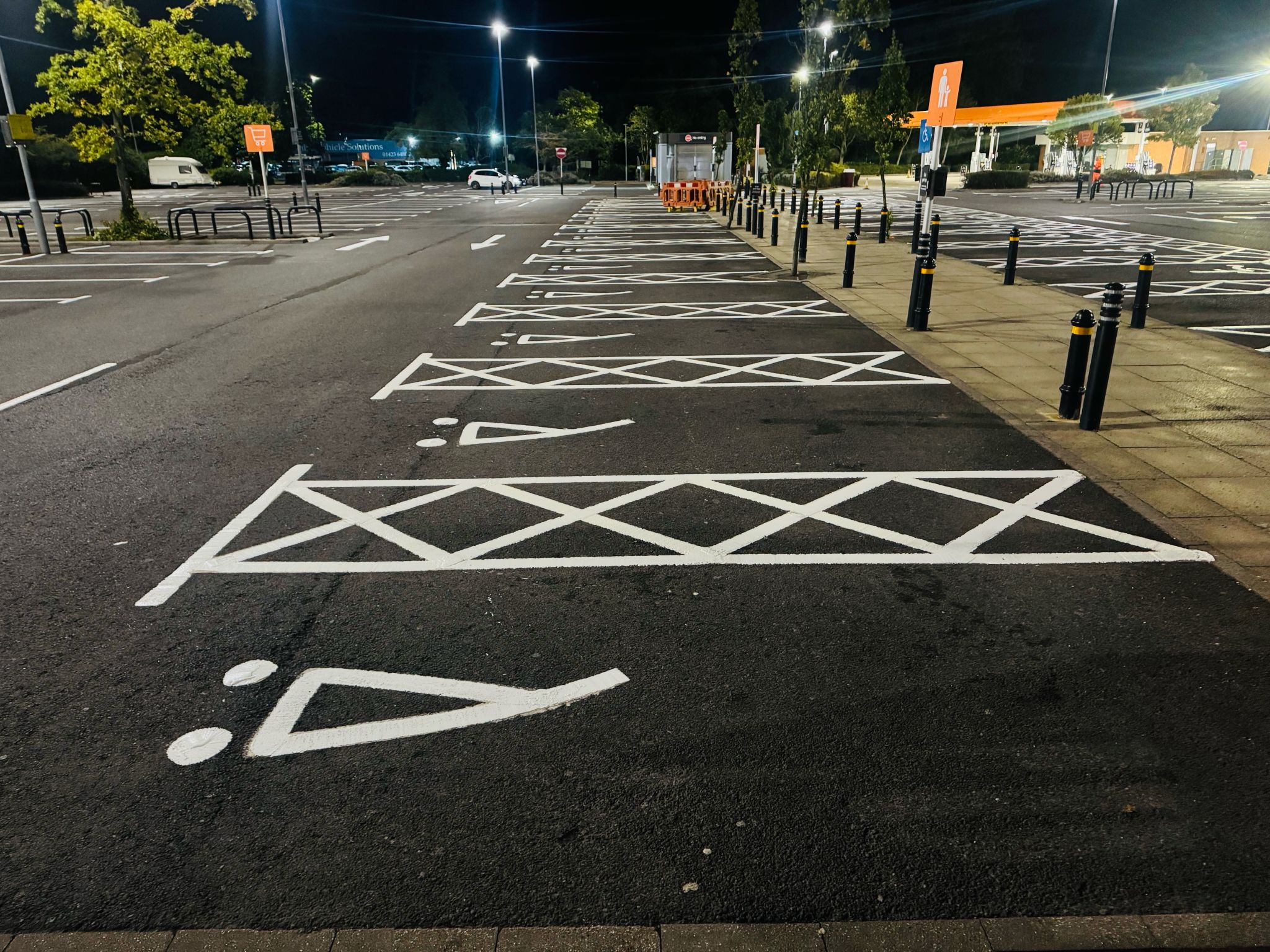
It’s one of those frustrations that facilities and property managers know all too well:
“We’ve just had the potholes fixed, so why does the car park look worse than it did before?”
The repairs themselves might be perfectly sound. The potholes are filled, the cracked sections are patched, the surface is structurally fine. But the car park looks like a patchwork of different colours, textures, and ages, with line markings that don’t quite line up any more.
It’s a common problem, and it’s almost always caused by repairs and line marking being treated as separate jobs rather than a coordinated piece of work.
The colour mismatch problem.
Fresh asphalt or patching material is noticeably darker than the surrounding weathered surface. On a car park that’s been down for several years, the contrast is stark.
Individual patches stand out against the faded grey of the existing surface, and the more patches there are, the more inconsistent the whole thing looks. Over time the patches will weather and fade to match, but that can take months or even years depending on traffic and exposure.
There’s no easy fix for this. It’s just the nature of patching an older surface. But being aware of it means you can plan around it rather than being surprised by the result.
Line markings that no longer line up.
This is where it really starts to look untidy.
When patches are laid across existing bay lines, directional arrows, or pedestrian markings, those markings get buried under the new surface material. What’s left is a bay line that runs cleanly up to a patch and then disappears, reappearing on the other side but not always in quite the same position.
If the line marking isn’t reinstated after patching, you end up with:
- Bays that look incomplete or misaligned
- Directional arrows that are partially missing
- Pedestrian crossings with gaps in them
- Hatching and symbols that have lost their definition
Drivers and pedestrians fill in the gaps themselves, and not always correctly. The layout that was clear before the repairs becomes confusing afterwards.
Why it happens.
The root cause is usually that the surface repair and the line marking are commissioned separately, often by different people, at different times, and sometimes through different contractors.
The typical sequence looks like this:
- Potholes or surface damage get reported
- A civils or surfacing contractor is brought in to carry out repairs
- The repairs are completed and signed off
- Weeks or months later, someone notices the line markings need redoing
- A line marking contractor is brought in as a separate job
By that point, the car park has been operating with mismatched surfaces and broken markings for longer than it needed to. And the line marking contractor is now working around patches they had no input on, some of which may not have been positioned or finished in a way that makes remarking straightforward.
How to avoid it.
The simplest way to get a better result is to plan the surface repairs and line marking together, even if different contractors are carrying out the work.
A few things that help:
- Scope both works at the same time. When commissioning patch repairs, include line marking reinstatement in the scope from the start rather than treating it as a follow-on.
- Brief the surfacing contractor on the marking layout. If they know where the bay lines, arrows, and symbols are, they can finish patches in a way that makes remarking easier.
- Schedule line marking shortly after repairs. The shorter the gap between patching and remarking, the less time the site spends looking unfinished.
- Use a contractor who can do both. If one contractor handles the surface repairs and the line marking, there’s no coordination gap between the two.
When a full refresh makes more sense.
If a car park has reached the point where it needs extensive patch repairs across large areas, it’s worth asking whether targeted patching is still the right approach or whether a more comprehensive refresh would give a better overall result.
Multiple patches across a car park, combined with faded and broken markings, can reach a point where the cumulative effect looks worse than the original damage did. At that stage, a planned programme of surface repair followed by a full remark often delivers better value and a much better visual result than continuing to patch and touch up incrementally.
It also gives you the opportunity to review the layout. Bay sizes, accessibility provision, EV bay locations, and traffic flow may all have changed since the car park was last fully marked.
The impression it makes.
This might seem like an aesthetic concern, but on a customer-facing site the condition of the car park is the first thing people see.
A car park covered in mismatched patches with broken line markings gives an impression of neglect, regardless of how well maintained the buildings are. For retail parks, hotels, offices, and healthcare sites, that first impression matters.
Coordinating repairs and markings so the finished result looks intentional rather than reactive is a relatively small extra step that makes a noticeable difference to how the site presents.
Conclusion.
So, why do car parks look worse after patch repairs?
Because the repairs fix the surface but disrupt the markings, and if the two aren’t coordinated, the result is a car park that’s structurally sound but visually messy and functionally confusing.
The fix is straightforward: plan surface repairs and line marking together, schedule them close together, and make sure the marking layout is reinstated properly once the patches are down.
If your car park has had repairs and the markings need bringing back up to standard, C&R Ltd can assess what’s needed and deliver a clean, coordinated result. We handle both surface preparation and line marking, which means there’s no gap between the two where things get missed.
Why Choose C&R.
As one of the UK’s leading specialists in line marking, surface preparation, coatings, and cleaning, C&R delivers expert advice, professional results, and long-lasting performance nationwide.
Over 30 Years’ Experience
Trusted nationwide by major brands and local authorities.
Fully Accredited & Insured
Working to UK safety and environmental standards.
Complete Start-to-Finish Service
From design and preparation to marking and aftercare.
Nationwide Coverage
Responsive teams operating across England, Scotland, and Wales.