
Who Is Responsible for Line Marking in a Retail Park?
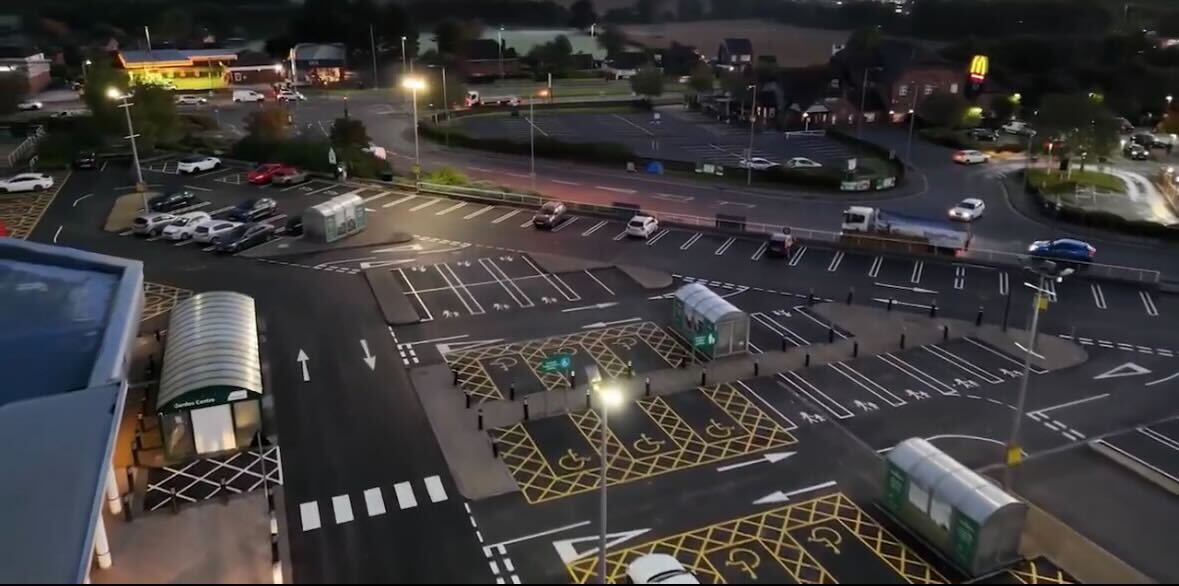
It’s one of those questions that sounds like it should have a simple answer, but rarely does:
“Whose job is it to maintain the line marking on a retail park?”
The landlord? The managing agent? The individual tenants? The facilities management company? It depends on the lease, the management structure, and sometimes on who shouts loudest when something needs doing.
The result is that on a lot of retail parks, line marking falls into a grey area where everyone assumes someone else is dealing with it. And that grey area is where things start to deteriorate.
Why it gets complicated.
Retail parks typically have shared areas, like the main car park, access roads, and pedestrian routes, alongside areas that sit closer to individual units, like service yards, loading bays, and dedicated customer parking zones.
The responsibility for maintaining these different areas is usually set out in the lease and the estate management arrangements, but it’s not always clear cut. Shared car parks often fall under the landlord or managing agent’s responsibility, funded through a service charge. But the specifics vary from site to site, and it’s not unusual for line marking to sit in a gap between what the landlord considers their obligation and what tenants expect to be covered.
Service charge budgets don’t always account for line marking as a standalone item either. It often gets bundled into general maintenance or deferred until a larger resurfacing project comes along, which can mean it goes years without being properly reviewed.
What happens when nobody takes ownership.
When responsibility for line marking isn’t clearly defined, or when it’s defined on paper but nobody actively manages it, the outcome is predictable.
Markings fade gradually. Bay lines become hard to read. Pedestrian routes lose definition. Disabled bays and EV charging bays become less visible. Hatching and directional arrows wear down to the point where drivers stop following them.
Because the deterioration is slow, it doesn’t tend to trigger an urgent response. It just quietly gets worse until something forces the issue, whether that’s a complaint from a tenant, an accessibility audit, an insurance review, or an incident in the car park.
By that point, the site usually needs a full remark rather than a targeted refresh, which costs more and causes more disruption than keeping on top of it would have done.
The safety and liability angle.
This is where it stops being just a maintenance question and becomes a risk management one.
On a retail park, the car park is often the first and last thing a customer interacts with. Poorly marked bays lead to chaotic parking. Faded pedestrian crossings put people at risk. Unclear directional markings create confusion, particularly on busy weekends or during peak trading periods.
If someone is injured on site and the line marking is found to have been inadequate or poorly maintained, the question of who was responsible for it becomes very real very quickly. Landlords, managing agents, and tenants can all find themselves drawn into liability discussions depending on how the management structure is set up.
Having a clear, documented approach to car park maintenance, including line marking, helps demonstrate that reasonable steps were being taken to keep the site safe. Not having one makes it much harder to defend.
How service charge arrangements affect things.
On most retail parks, communal area maintenance is funded through the service charge. In theory, this should cover regular upkeep of car park markings along with everything else.
In practice, line marking often gets deprioritised. It competes with more visible or more urgent items like landscaping, lighting, drainage, and general repairs. Because faded line marking doesn’t cause an immediate operational problem in the way a broken barrier or a failed light does, it tends to slide down the priority list.
The difficulty is that by the time it becomes urgent enough to act on, the scope of work is usually much larger than it would have been if it had been addressed as part of a regular maintenance cycle. A planned refresh every two to three years is almost always more cost effective than a reactive full remark every five or six.
Getting ahead of the problem.
The most straightforward way to avoid the “whose job is it” question is to build line marking into the planned maintenance programme for the estate, with clear ownership and a realistic budget.
That means someone, whether it’s the managing agent, the FM provider, or the landlord’s representative, actively reviewing the condition of the markings on a regular basis and flagging when work is needed. It doesn’t have to be complicated. A walkround once or twice a year, with photos and notes on areas of concern, gives you enough to plan proportionate work rather than waiting for a crisis.
It also helps to work with a contractor who understands retail park environments, including the access constraints, trading hours, phasing requirements, and the need to keep disruption to tenants and customers as low as possible.
Conclusion.
So, who is responsible for line marking on a retail park?
It depends on the lease and management arrangements, but the more important question is whether anyone is actively managing it. Clear ownership, regular review, and planned maintenance are what stop line marking from becoming a problem that nobody noticed until it was too late.
If you manage or operate a retail park and you’re not sure what condition the car park markings are in, C&R Ltd can carry out a site assessment and help you put a practical maintenance plan in place. We work on retail parks across the country and understand the operational realities of keeping these sites running smoothly.
Why Choose C&R.
As one of the UK’s leading specialists in line marking, surface preparation, coatings, and cleaning, C&R delivers expert advice, professional results, and long-lasting performance nationwide.
Over 30 Years’ Experience
Trusted nationwide by major brands and local authorities.
Fully Accredited & Insured
Working to UK safety and environmental standards.
Complete Start-to-Finish Service
From design and preparation to marking and aftercare.
Nationwide Coverage
Responsive teams operating across England, Scotland, and Wales.