
What Role Does Line Marking Play in Fire Safety? | C&R Ltd
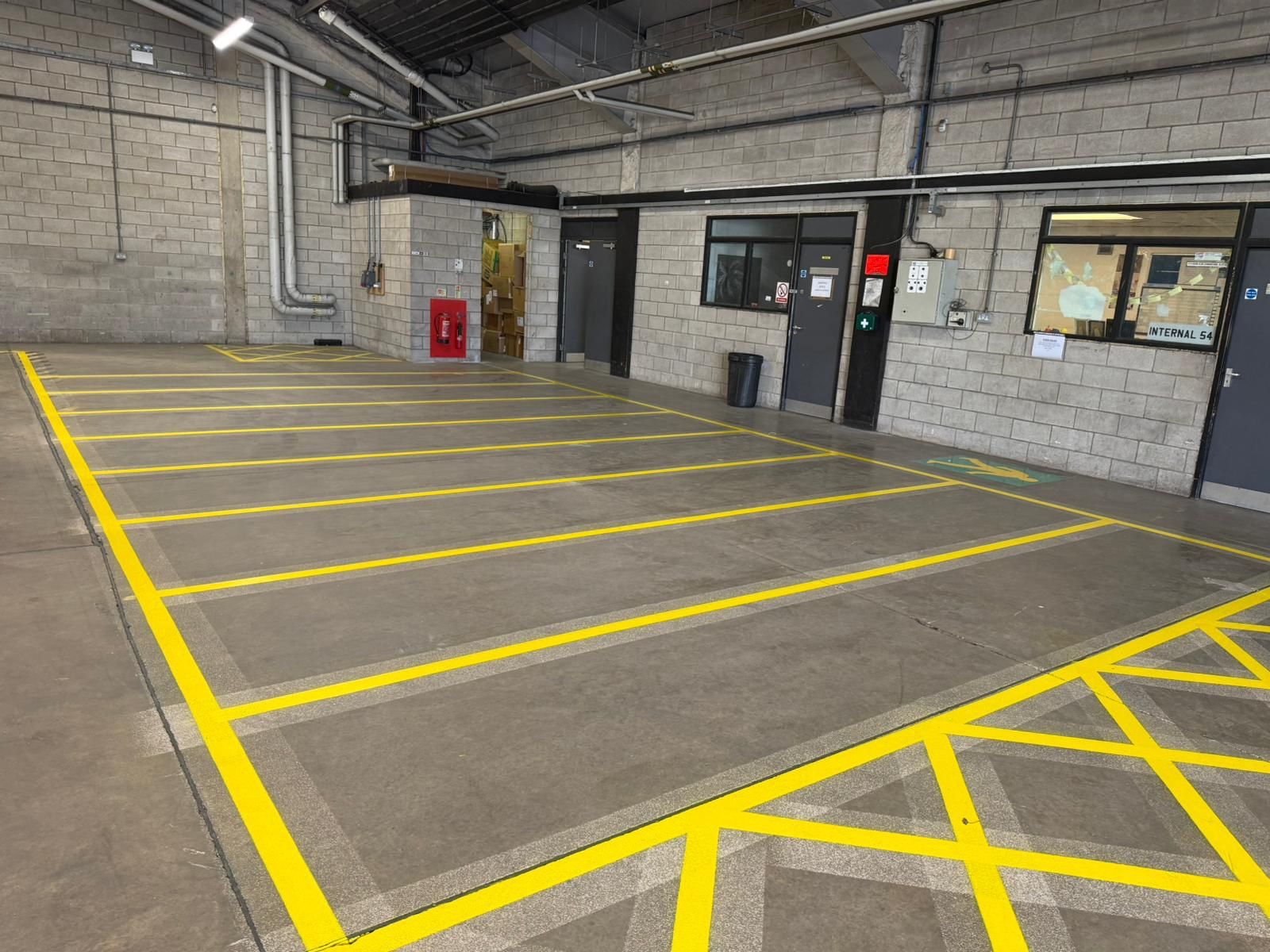
Fire safety on commercial sites involves a lot of things that are well understood. Fire alarms, extinguishers, sprinkler systems, fire doors, evacuation plans. But one element that’s often overlooked is the role that floor marking plays in keeping a site safe and accessible in an emergency.
“Does line marking actually have anything to do with fire safety?”
More than most people realise. From keeping fire exits clear to making sure emergency vehicles can get to the building, line marking supports fire safety in ways that only become obvious when it’s missing or has failed.
Keeping fire exits and escape routes clear.
Fire exits need to be accessible at all times. That sounds obvious, but on busy commercial sites, things get left in front of fire doors. Pallets stack up. Vehicles park where they shouldn’t. Deliveries get dumped in the nearest available space.
Clear floor markings around fire exits and along escape routes help prevent this by defining the space that must be kept clear. Hatched zones in front of fire doors, marked corridors leading to exits, and “keep clear” markings all reinforce the message visually, even when there’s nobody around to enforce it.
In warehouses especially, where stock levels and layouts shift constantly, floor markings provide a fixed reference point that doesn’t move with the inventory.
Fire assembly points.
Fire assembly points need to be clearly identifiable so that people can find them quickly during an evacuation. Vertical signage plays a role, but ground-level markings help too, particularly on large sites where the assembly point might be in a car park or open area.
Floor markings at assembly points can include:
- The assembly point symbol or text marked on the ground
- A defined area outlined with boundary lines so people know where to gather
- Hatching or colour to differentiate the zone from surrounding parking or traffic areas
On sites where the assembly point is in a car park, marking it clearly also helps prevent vehicles from parking on it during normal operations. An assembly point that’s full of parked cars when the alarm goes off isn’t much use.
Emergency vehicle access.
Fire engines, ambulances, and other emergency vehicles need to reach the building quickly and without obstruction. On commercial sites, that means certain routes and areas need to be kept clear at all times.
Line marking supports this by:
- Defining and hatching fire access routes so they’re visibly different from general parking or circulation areas
- Marking “no parking” or “keep clear” zones near building entrances, dry risers, fire hydrants, and other access points
- Creating turning areas large enough for emergency vehicles, clearly marked so they don’t get blocked by parked cars or deliveries
If a fire engine can’t reach the building because someone’s parked on an unmarked access route, the consequences could be severe. Clear marking doesn’t guarantee compliance, but it removes the excuse that nobody knew the area needed to stay clear.
Fire equipment zones.
Inside warehouses and industrial buildings, fire equipment such as extinguishers, hose reels, and alarm call points needs to be accessible without obstruction.
Floor markings around fire equipment typically use red hatching or a red boundary box to define a clear zone that must not be blocked. This is standard practice in warehouses and factories, and it’s one of the things fire risk assessors and HSE inspectors look for during site visits.
If the markings around fire equipment have faded or been covered by racking, stock, or other obstructions, it’s often flagged as a non-compliance issue. Keeping these markings maintained and visible is a simple step that avoids a common audit finding.
Colour conventions for fire safety markings.
There are recognised colour conventions for fire-related floor markings, though they’re not rigidly standardised on private sites.
The most common approach:
- Red for fire equipment zones, fire exit keep-clear areas, and fire access routes
- Red and white hatching for areas around fire doors and emergency exits
- Yellow and black for general hazard warnings, which can include fire risk areas in some environments
- Green for safe routes and emergency exit pathways (matching the green of fire exit signage)
Using consistent, recognisable colours helps people respond instinctively rather than having to stop and read signage during an emergency. The whole point is that the markings communicate something immediately, without needing explanation.
How fire safety markings get neglected.
Fire safety floor markings tend to suffer from the same problem as other types of line marking on busy sites. They fade gradually, and because people see them every day, nobody notices until they’re barely visible.
Common issues include:
- Hatching around fire exits worn away by foot traffic or vehicle movements
- Fire equipment zones covered by stock, racking, or temporary storage
- Assembly point markings faded or partially obscured by parked vehicles
- Emergency access routes unmarked or indistinguishable from standard parking areas
- New racking or layout changes covering or blocking previously marked fire zones
Including fire safety markings in your regular marking review means they get maintained alongside everything else rather than only getting attention after an audit or incident.
The compliance angle.
The Regulatory Reform (Fire Safety) Order 2005 places a duty on the responsible person to carry out a fire risk assessment and take reasonable steps to reduce risk and ensure safe evacuation.
While the legislation doesn’t specifically mandate floor markings, a fire risk assessment that identifies issues with exit access, emergency vehicle routes, or fire equipment accessibility will often recommend floor markings as a practical control measure.
Having clear, maintained fire safety markings demonstrates that the site operator is actively managing fire risk. Not having them, particularly where a fire risk assessment has recommended them, creates a gap that’s hard to justify.
Warehouses and industrial sites.
Fire safety marking is particularly important in warehouse and industrial environments where:
- The building layout changes regularly as stock levels and operations evolve
- Racking and stored goods can easily block fire exits and equipment
- Vehicle and pedestrian traffic is heavy, increasing both the risk and the wear on markings
- The distances to fire exits can be significant, making marked escape routes more critical
In these environments, fire safety floor markings aren’t optional extras. They’re a fundamental part of how the site manages its fire risk, and they need maintaining with the same priority as any other fire safety system.
Conclusion.
So, what role does line marking play in fire safety on commercial sites?
It keeps fire exits clear, defines assembly points, protects emergency vehicle access, marks fire equipment zones, and supports safe evacuation routes. It’s not a replacement for fire alarms, extinguishers, or sprinkler systems, but it’s part of the same framework that keeps people safe.
If your fire safety markings have faded, been covered, or haven’t been reviewed recently, C&R Ltd can assess what’s needed and bring them back up to standard. It’s a straightforward job that makes a real difference to how your site performs in an emergency and how it’s viewed during a fire risk assessment.
Why Choose C&R.
As one of the UK’s leading specialists in line marking, surface preparation, coatings, and cleaning, C&R delivers expert advice, professional results, and long-lasting performance nationwide.
Over 30 Years’ Experience
Trusted nationwide by major brands and local authorities.
Fully Accredited & Insured
Working to UK safety and environmental standards.
Complete Start-to-Finish Service
From design and preparation to marking and aftercare.
Nationwide Coverage
Responsive teams operating across England, Scotland, and Wales.