
How Do You Plan Line Marking for a Multi-Storey Car Park? | C&R Ltd
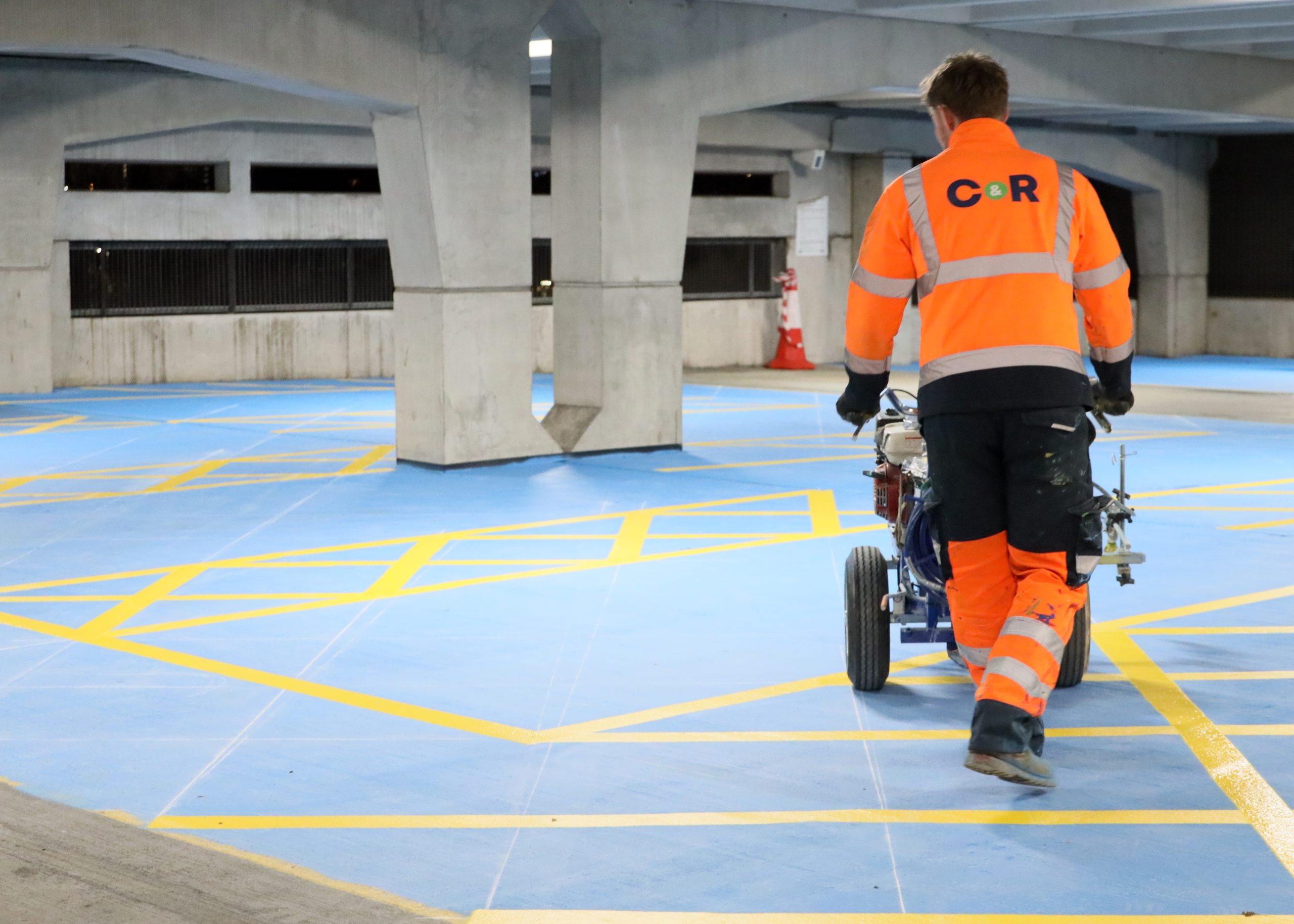
Multi-storey car parks bring a set of challenges that surface-level sites don’t. Tight spaces, ramps, low ceilings, limited ventilation, and the fact that closing one level affects the whole structure.
“How do you actually plan and deliver line marking across multiple levels without causing chaos?”
It takes more thought than a standard car park job. The logistics of access, phasing, material choice, and ventilation all need working through before anyone picks up a spray gun.
Why multi-storeys are different.
On a surface-level car park, you can usually work in one area while the rest stays open. Traffic flows around the closed section and life carries on.
In a multi-storey, everything is connected. Closing a level affects the levels above and below it. Ramps link everything together, so restricting access on one floor has knock-on effects for circulation through the whole structure. The capacity drops more noticeably because users can’t simply park in another part of the same open space.
That makes phasing more critical and the programme less forgiving.
Access and logistics.
Getting equipment into a multi-storey car park isn’t always straightforward.
Things that need considering:
- Height restrictions. Larger marking vehicles and equipment may not fit under barriers or low ceilings. Knowing the clearance heights across all levels before the job starts avoids problems on the day.
- Ramp access. Equipment needs to move between levels, and ramps may be steep, tight, or one-way. If a ramp is closed for marking, there may be no alternative route between floors.
- Material storage. Paint, thermoplastic, and equipment need to be stored somewhere accessible but out of the way. On a tight multi-storey site, that’s not always easy.
- Waste removal. Shot blasting debris, old marking material, and general waste need to come off site. Getting it from an upper level to ground level adds time.
A site visit before quoting is essential on multi-storey jobs. Plans and drawings don’t always show the practical constraints that become obvious the moment you walk the levels.
Ventilation.
This is one of the biggest differences between working in a multi-storey and working outside.
Many line marking materials produce fumes during application. On an open surface, those fumes disperse naturally. In an enclosed or semi-enclosed multi-storey structure, they can build up quickly, creating health risks for operatives and anyone else in the building.
Material choice needs to account for this:
- Low-odour or water-based paints may be more appropriate than solvent-based systems in enclosed areas
- MMA systems produce strong fumes and may require mechanical ventilation or extraction during application
- Thermoplastic generates less fume than MMA but still needs adequate airflow
The ventilation assessment should happen at the survey stage, not on the first day of work. If the structure doesn’t have adequate natural airflow, additional measures need planning and costing into the project.
Phasing across levels.
Phasing a multi-storey job requires more thought than simply working floor by floor from top to bottom.
Factors that influence the phasing plan:
- Which levels can be closed together. Closing two adjacent levels may be acceptable if the remaining capacity is enough. Closing the wrong combination might cut off access entirely.
- Ramp closures. If a ramp needs marking, traffic flow between levels is disrupted. This often needs to happen at the quietest time, sometimes overnight.
- Peak usage patterns. Shopping centre car parks are busiest at weekends. Hospital car parks are busy during the day. Office car parks are busiest Monday to Friday. The phasing plan should work around these patterns.
- Stairwell and lift access. Even when a level is closed to vehicles, pedestrians may still need to pass through to reach stairs or lifts. Safe pedestrian routes through the work area need maintaining.
The phasing plan should be agreed with the site operator before work starts, with clear communication about what’s closed, when, and how the remaining capacity is managed.
Ramps, turns, and tight geometry.
Multi-storey car parks are full of curves, ramps, tight turning areas, and angled bays. Marking these accurately takes skill and experience.
Common challenges include:
- Ramp markings. Direction arrows, lane dividers, and speed warnings on ramps need to be positioned so they’re visible to drivers at the right angle and distance. A marking that looks fine when you’re standing next to it can be invisible from behind a steering wheel on a downward ramp.
- Angled bays. Many multi-storeys use angled bays to improve traffic flow. Setting these out consistently across a full level requires careful measurement, because small errors compound over a long run of bays.
- Column obstructions. Structural columns sit within or adjacent to bays on most multi-storey layouts. Bay lines need to account for columns without creating confusion about where the bay actually is.
- Tight radii. Turning areas at the ends of aisles and around ramp entries are difficult to mark accurately with standard equipment. These areas need an operator who can handle curves cleanly.
Material considerations.
The enclosed or semi-enclosed environment of a multi-storey affects material choice beyond just the ventilation issue.
Other factors include:
- Drying and curing time. In an enclosed space with less airflow, materials may take longer to cure. That extends the time each section needs to stay closed.
- Surface type. Multi-storey floors are often power-floated concrete, which can be very smooth. This may need preparation to give the marking material enough key to bond.
- Waterproofing coatings. Some multi-storey decks have waterproof membrane coatings. Line marking needs to be compatible with the membrane, and the membrane shouldn’t be damaged during preparation.
- Durability on ramps. Ramp surfaces take heavy wear from braking and turning. More durable materials or anti-slip additions may be needed in these areas.
Communication with users.
On any live car park job, communication matters. On a multi-storey it matters more because the impact of closures is felt more acutely.
Users need to know:
- Which levels are available and which are closed
- Whether the total capacity is reduced and by how much
- How long the closures will last
- Whether alternative parking arrangements are in place
Signage at the entrance, updates to any digital capacity systems, and advance notice to regular users or tenants all help keep things running smoothly. Most frustration comes from people arriving and discovering half the car park is closed with no warning.
Conclusion.
So, how do you plan line marking for a multi-storey car park?
By understanding the structure, working through the access and ventilation constraints, phasing the work around capacity and usage patterns, choosing materials that suit the enclosed environment, and communicating clearly with everyone affected.
It’s more complex than a surface-level car park, but with the right planning it doesn’t need to be disruptive. The key is treating it as a coordinated project rather than a simple marking job.
If you’re planning line marking works in a multi-storey car park, C&R Ltd can survey the structure, work through the practical constraints, and put together a phased programme that keeps the car park operational throughout. We work on multi-storey sites regularly and understand the challenges that come with them.
Why Choose C&R.
As one of the UK’s leading specialists in line marking, surface preparation, coatings, and cleaning, C&R delivers expert advice, professional results, and long-lasting performance nationwide.
Over 30 Years’ Experience
Trusted nationwide by major brands and local authorities.
Fully Accredited & Insured
Working to UK safety and environmental standards.
Complete Start-to-Finish Service
From design and preparation to marking and aftercare.
Nationwide Coverage
Responsive teams operating across England, Scotland, and Wales.