
Do EV Charging Bays Need Special Line Marking? | C&R Ltd
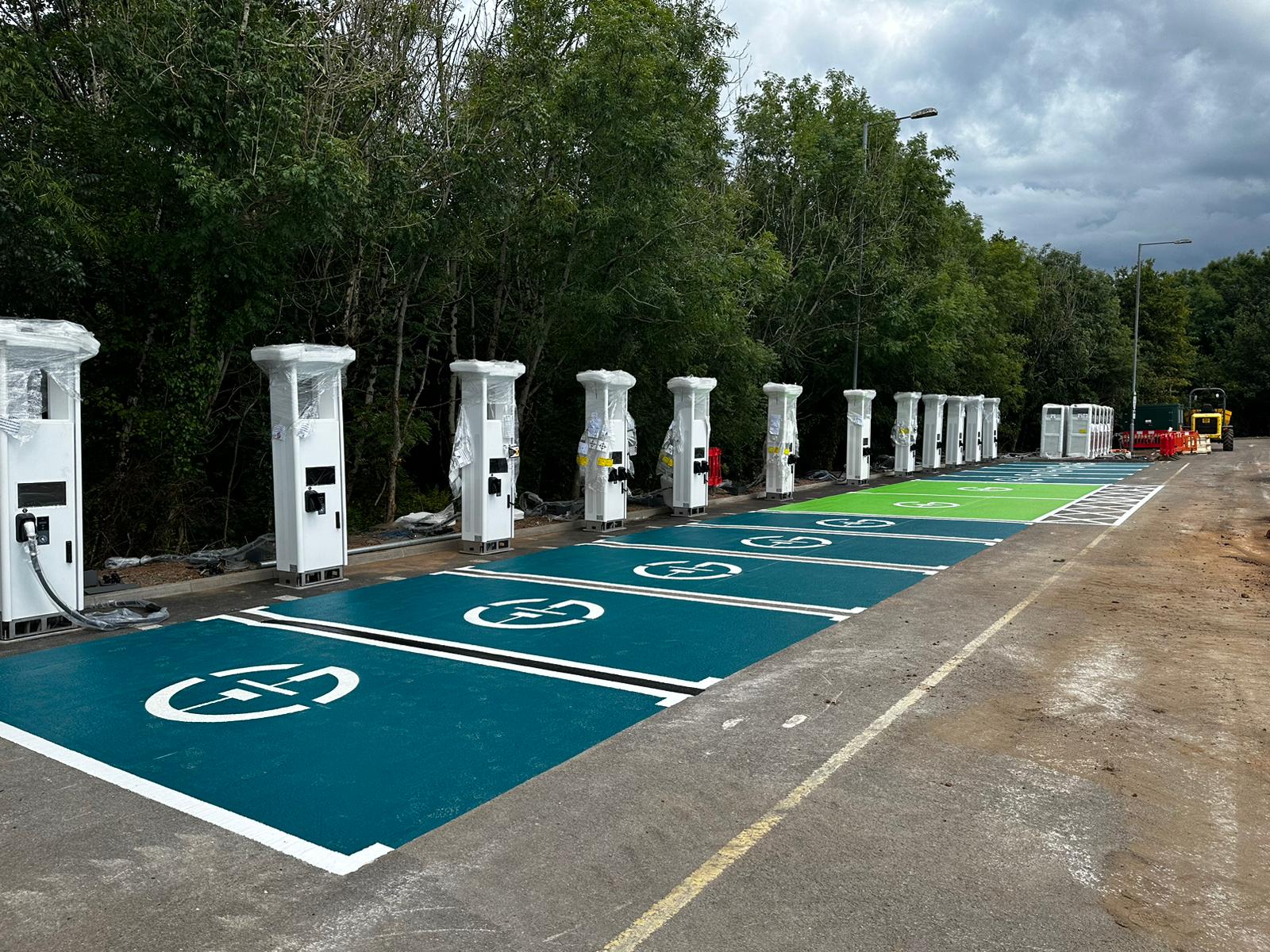
EV charging bays are appearing on car parks across the country, from retail parks and supermarkets to offices, hotels, and public car parks. But the line marking around them is often inconsistent.
“Do EV charging bays actually need special marking, or can you just put a charger next to a standard bay?”
It’s a reasonable question, and the answer is that while there isn’t a single mandatory standard for EV charging bay line marking on private land, getting it wrong creates problems that are easy to avoid with a bit of thought upfront.
Is there a legal requirement?
On private land, there’s no specific law that dictates exactly how an EV charging bay must be marked. There’s no equivalent of the TSRGD highway regulations for EV bays on commercial sites.
However, there are strong expectations. Building Regulations Approved Document S sets out requirements for EV charging infrastructure in new buildings, and while it focuses mainly on the electrical provision, it assumes that bays will be clearly identifiable and accessible.
Beyond that, local planning conditions often include requirements around EV bay provision and marking as part of development approvals. And operators have general duties under the Equality Act 2010 to ensure that EV bays, like all parking, are accessible.
So while the marking itself isn’t prescribed in law, there’s a clear expectation that EV bays are properly identified, safely laid out, and accessible to all users.
Why standard bay marking isn't enough.
Dropping a charger next to a standard parking bay and calling it an EV space creates several issues:
- Identification. Without clear marking, drivers may not recognise the bay as an EV charging space, leading to ICE vehicles parking there.
- Cable management. Charging cables need to reach the vehicle without trailing across walkways or adjacent bays. Bay layout needs to account for this.
- Accessibility. If any EV bays are designated as accessible, they need the additional width and transfer space required for wheelchair users, just like standard disabled bays.
- Safety. Charger locations, cable routes, and pedestrian movement around charging bays all need to be considered in the marking layout.
A standard bay with a charger bolted nearby might technically work, but it doesn’t give users clarity, and it doesn’t protect the site operator if something goes wrong.
What good EV bay marking looks like.
There’s no single mandated layout, but best practice has settled into a fairly consistent approach across well managed sites:
- Green bay markings to visually distinguish EV bays from standard parking. This has become the widely recognised convention in the UK.
- EV symbol or text within the bay, usually a plug symbol or “EV ONLY” marking to make the purpose clear at ground level.
- Vertical signage reinforcing that the bay is for EV charging only, ideally with information about any time limits or usage conditions.
- Hatching around charger units to keep a clear zone around the equipment and prevent vehicles from parking too close to the infrastructure.
- Cable route markings where charging cables cross pedestrian areas, to highlight trip hazards.
The goal is that anyone driving into the car park can immediately identify the EV bays, understand that they’re restricted, and use them safely.
Accessible EV bays.
This is an area that’s often overlooked in the rush to install charging infrastructure.
A proportion of EV charging bays should be accessible to disabled users. This means wider bays with transfer zones, positioned close to building entrances and connected to step-free pedestrian routes, just as standard disabled bays would be.
The marking for accessible EV bays typically combines the green EV bay colour with the standard wheelchair symbol and the additional width required under BS 8300 guidance. Getting this right from the start avoids having to retrofit later when the oversight gets flagged.
As EV ownership grows, the expectation around accessible charging provision is only going to increase. Sites that plan for it now will be ahead of the curve.
Common mistakes with EV bay marking.
A few things we see regularly on sites where EV bays have been added without much thought:
- No colour differentiation from standard bays, making them hard to spot
- Bays too narrow for comfortable cable connection, especially on the offside
- No hatching around charger units, leading to vehicles parking against the equipment
- Accessible bays forgotten entirely, with all EV bays at standard width
- No ground-level marking, relying entirely on a small sign on the charger post that’s easy to miss
Most of these are straightforward to fix with a proper marking scheme, and much easier to get right at installation stage than to correct afterwards.
Planning EV bay marking as part of a wider scheme.
EV bays work best when they’re planned as part of the overall car park layout rather than squeezed in as an afterthought.
Things to consider:
- Where the chargers are positioned relative to building entrances and pedestrian routes
- How many bays are needed now and whether the layout allows for future expansion
- Which bays need to be accessible and where those sit in relation to the building
- How the EV bay marking fits with the existing car park colour scheme and wayfinding
- Whether the surface needs any preparation before marking, particularly if the bays are on older asphalt
Getting the marking right at the same time as the electrical installation saves disruption and ensures the bays are usable from day one.
Conclusion.
So, do EV charging bays need special line marking?
There’s no single legal requirement on private land, but clear, consistent EV charging bay line marking is strongly recommended and increasingly expected. Green bays, clear symbols, accessible provision, and safe layouts are all part of getting it right.
If you’re installing EV chargers or reviewing your existing EV bay provision, C&R Ltd can help with the marking layout, accessibility requirements, and surface preparation. We’re marking EV bays on sites across the country and can make sure yours are clear, compliant, and ready to use.
Why Choose C&R.
As one of the UK’s leading specialists in line marking, surface preparation, coatings, and cleaning, C&R delivers expert advice, professional results, and long-lasting performance nationwide.
Over 30 Years’ Experience
Trusted nationwide by major brands and local authorities.
Fully Accredited & Insured
Working to UK safety and environmental standards.
Complete Start-to-Finish Service
From design and preparation to marking and aftercare.
Nationwide Coverage
Responsive teams operating across England, Scotland, and Wales.