
How Should Pedestrian Routes Be Marked on a Commercial Site? | C&R Ltd
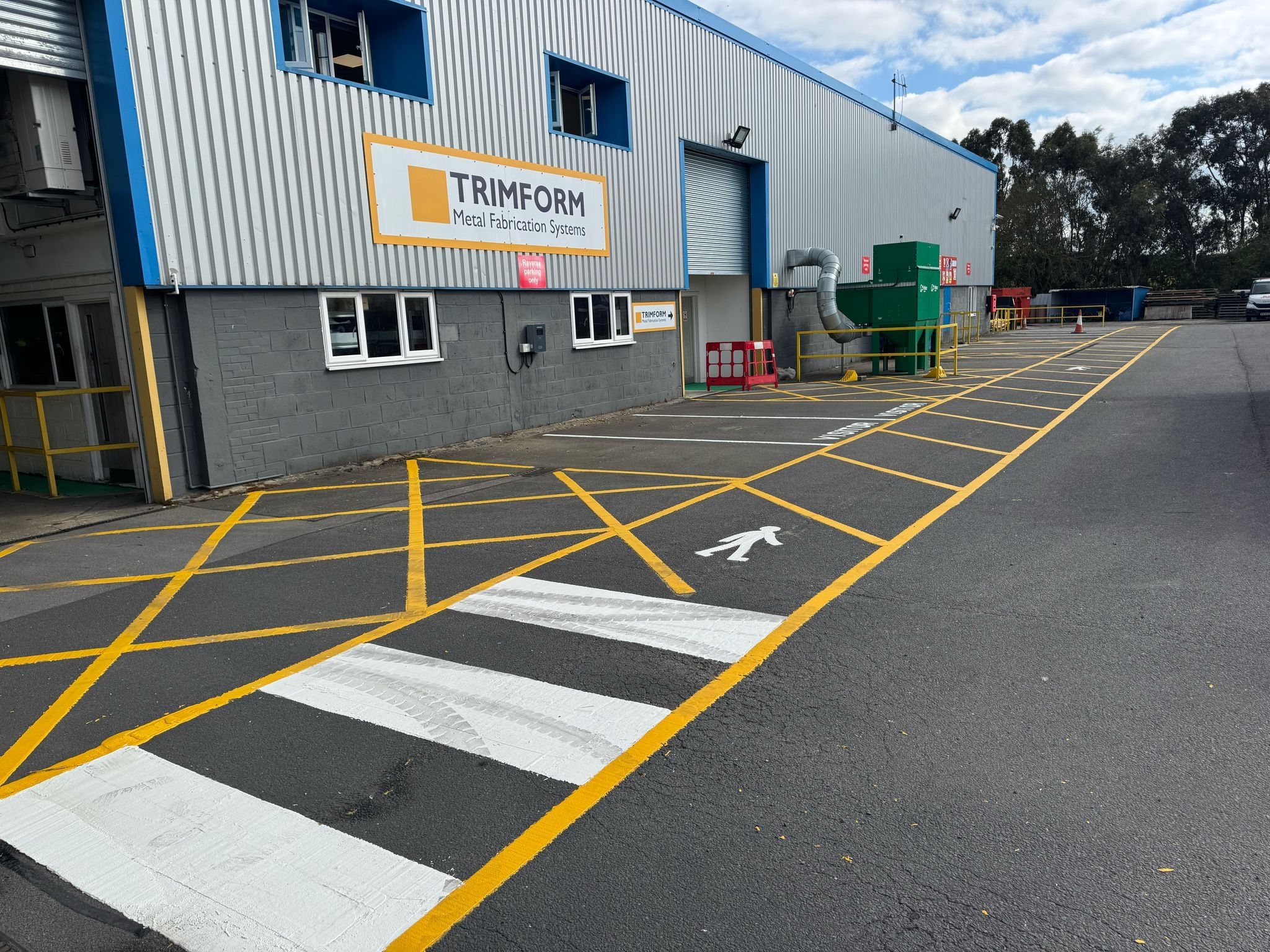
On a lot of commercial sites, pedestrian routes are an afterthought. Bays get marked, arrows go down, disabled spaces are positioned near the entrance, and then someone asks:
“What about the pedestrians?”
It’s a question that should come first, not last. Pedestrians are the most vulnerable users on any site where vehicles are moving, and yet their routes are often the least defined part of the marking scheme.
Why pedestrian marking matters.
The simplest way to put it is that people on foot and vehicles don’t mix well. On car parks, service yards, industrial estates, and warehouse yards, pedestrians and vehicles are sharing the same space. Without clear separation, people make their own decisions about where to walk, and those decisions aren’t always safe ones.
Clear pedestrian route marking does a few things:
- Gives people on foot a defined, visible path to follow
- Tells drivers where to expect pedestrians
- Creates a framework for managing risk in shared spaces
- Supports compliance with health and safety obligations
On sites where there’s been an incident involving a pedestrian, one of the first things that gets examined is whether the pedestrian routes were clearly marked and whether the layout directed people away from vehicle movements. If the answer is no, the site operator’s position is difficult to defend.
Where pedestrian routes are needed.
Not every square metre of a site needs a marked walkway. But there are common areas where pedestrian marking should be considered as standard:
- Car park to building entrance. The route between where people park and where they’re going. This is the most basic pedestrian route and the one most often missing or poorly defined.
- Crossing points. Where pedestrian routes cross vehicle lanes, clear crossing markings tell both pedestrians and drivers what to expect.
- Service yards and loading areas. These are high risk zones where HGVs, forklifts, and pedestrians can all be present. Pedestrian routes through or around these areas need to be clearly defined and, ideally, physically separated where possible.
- Between buildings on multi-unit sites. On retail parks, industrial estates, and business parks, people walk between units. If that route crosses vehicle traffic, it needs marking.
- Around warehouse entrances. The transition between internal pedestrian routes and external vehicle areas is a common pinch point where clear marking helps manage the risk.
What good pedestrian marking looks like.
There’s no single mandatory standard for pedestrian route marking on private land, but best practice is well established and most sites benefit from following a consistent approach.
Walkway lines. Continuous lines defining the edges of the pedestrian route. These are typically white or yellow depending on the site’s colour scheme. The lines should be wide enough to be clearly visible, and the walkway itself should be wide enough for two people to pass comfortably.
Crossing points. Where pedestrians need to cross a vehicle route, zebra-style markings or clearly hatched crossing zones make the point of interaction visible to both parties. These don’t carry the legal status of a public highway zebra crossing, but they serve the same practical purpose on a private site.
Surface colour or texture. On some sites, particularly warehouses and industrial facilities, the pedestrian route is differentiated by colour rather than just lines. A painted walkway in a contrasting colour is more visible than lines alone, especially in busy or cluttered environments.
Signage and symbols. Pedestrian symbols within the walkway and “pedestrians only” signs at entry points reinforce the message. On sites with a mix of regular users and visitors, this helps people who aren’t familiar with the layout.
Anti-slip treatment. On external routes that get wet, or on smooth internal floors, anti-slip coatings on the pedestrian walkway add a layer of safety that complements the visual marking.
Common mistakes.
A few things we see regularly on sites where pedestrian routes haven’t been thought through properly:
- Routes that start but don’t connect. A walkway from the car park that stops short of the building entrance, leaving pedestrians to cross a vehicle lane with no marking for the last 20 metres.
- Routes that force people into traffic. A pedestrian path that runs alongside a vehicle lane with no buffer or separation, or one that directs people through a loading bay area.
- Too narrow. A walkway that’s technically marked but so narrow that people walk outside it to pass each other or to avoid obstacles.
- Faded to the point of invisibility. Pedestrian markings that were clear when first applied but have worn away without being refreshed. If you can’t see the walkway, it’s not doing its job.
- No crossing points. Walkways on either side of a vehicle lane with no defined crossing, leaving pedestrians to pick their own moment to cross.
Most of these are avoidable with a bit of thought at the design stage and regular maintenance once the markings are down.
Warehouses and industrial sites.
Pedestrian route marking takes on extra importance in warehouse and industrial environments where the consequences of a vehicle and pedestrian interaction are more severe.
Forklifts, reach trucks, and other MHE operate in close proximity to pedestrians in most warehouses. The HSE takes pedestrian and vehicle segregation seriously in these environments, and clear floor marking is one of the primary ways to demonstrate that the risk is being managed.
In warehouses, pedestrian routes are typically:
- Marked in a contrasting colour, often yellow or green
- Defined by continuous lines with hatching or filled colour
- Positioned to keep pedestrians away from racking aisles and vehicle turning areas
- Connected to safe crossing points where pedestrian and vehicle routes intersect
- Reinforced with physical barriers where the risk justifies it
The standard expected in a warehouse is generally higher than in a car park because the traffic is heavier, the vehicles are less predictable, and the operators may have limited visibility.
Keeping pedestrian routes maintained.
Pedestrian markings tend to wear faster than bay lines because they’re in areas of constant foot traffic. Scuffing, cleaning, and general wear take their toll, and because the markings are on the ground rather than at eye level, people stop noticing them once they fade.
Including pedestrian routes in your regular marking review is important. If the walkway lines have faded to the point where people are walking outside them or ignoring them entirely, the route isn’t providing the protection it’s supposed to.
Refreshing pedestrian markings is usually a quick, targeted job that can be done without major disruption. It’s a small investment that maintains one of the most important safety features on the site.
Conclusion.
So, how should pedestrian routes be marked on a commercial site?
With clear, continuous walkways that connect parking areas to building entrances, defined crossing points where pedestrians and vehicles interact, and appropriate width, colour, and visibility for the environment. They should be designed as part of the overall layout, not added as an afterthought, and maintained regularly so they keep doing their job.
If your site’s pedestrian routes need reviewing or the markings have faded to the point where they’re no longer effective, C&R Ltd can assess the layout and recommend a practical approach. Pedestrian safety is one of the most important things line marking does, and it deserves proper attention.
Why Choose C&R.
As one of the UK’s leading specialists in line marking, surface preparation, coatings, and cleaning, C&R delivers expert advice, professional results, and long-lasting performance nationwide.
Over 30 Years’ Experience
Trusted nationwide by major brands and local authorities.
Fully Accredited & Insured
Working to UK safety and environmental standards.
Complete Start-to-Finish Service
From design and preparation to marking and aftercare.
Nationwide Coverage
Responsive teams operating across England, Scotland, and Wales.