
The Most Common Car Park Line Marking Mistakes | C&R Ltd
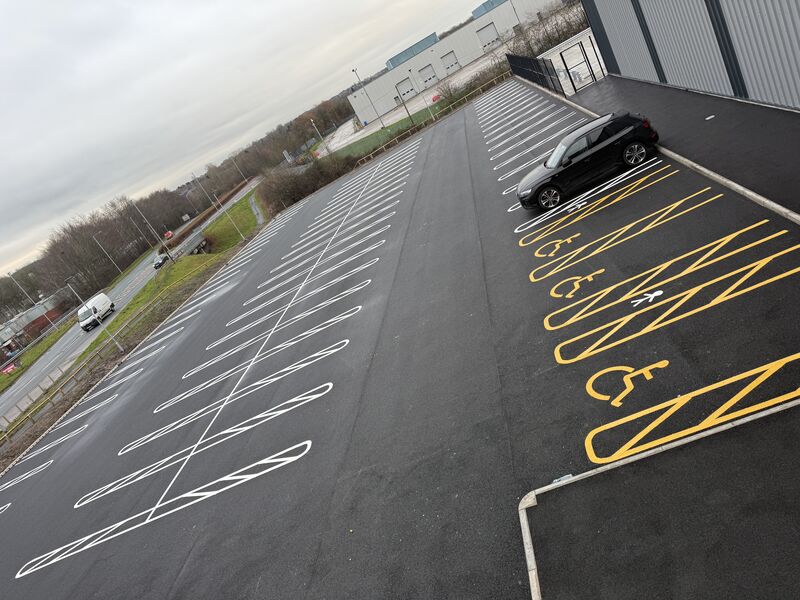
Most car parks look fine at a glance. Bays are marked, arrows point in the right direction, and the disabled spaces are near the entrance. Job done.
But look a bit closer and you’ll often find problems that affect how the car park actually works. Layout issues, material choices, and shortcuts that seemed harmless at the time but cause ongoing frustration, confusion, or risk.
“What are the mistakes that keep coming up, and how do you avoid them?”
Here are the ones we see most often.
Bays that are too narrow.
This is probably the single most common car park line marking mistake, and it usually happens because someone has tried to squeeze in as many spaces as possible.
Standard car parking bays in the UK are typically 2.4 metres wide. That was fine 20 years ago, but modern vehicles are wider than they used to be. SUVs, crossovers, and electric vehicles with wider wheelbases all struggle in bays designed for smaller cars.
The result is:
- Doors hitting adjacent vehicles
- Drivers avoiding tight bays and parking elsewhere
- Vehicles overhanging into adjacent bays or traffic lanes
- More complaints from customers and tenants
On a car park where space allows, slightly wider bays reduce damage, improve flow, and make the site more pleasant to use. Fewer, wider bays often work better than more, narrower ones.
Disabled bays that don't meet guidance.
Getting the wheelchair symbol in a bay near the entrance is the minimum. But a lot of sites stop there without considering whether the bay actually works for someone who needs it.
Common issues include:
- Bays at the right width but without proper hatched transfer zones
- Bays positioned where the access route crosses live traffic
- No step-free connection between the bay and the building entrance
- Transfer zones blocked by bollards, kerbs, or landscaping
Following BS 8300 guidance on dimensions and positioning helps avoid these problems. A disabled bay that looks compliant but isn’t practically usable doesn’t meet the spirit of the Equality Act, even if it technically ticks a box.
No consideration for traffic flow.
Line marking defines how a car park operates, but too often the layout focuses on maximising bay numbers without thinking about how vehicles actually move through the space.
This leads to:
- Awkward turning circles at the end of aisles
- Conflicting traffic directions with no clear priority
- Pedestrians forced to walk through live traffic lanes
- Delivery vehicles unable to navigate without crossing bay markings
A good layout balances capacity with circulation. Directional arrows, pedestrian routes, and clear aisle widths all contribute to a car park that flows rather than one that creates bottlenecks.
Painting over old markings instead of removing them.
When a car park layout changes, the old markings need to come out before the new ones go down. Painting over them or simply applying the new layout on top of the old one creates ghost lines that confuse drivers.
We’ve covered ghost lines in detail in a separate blog, but in short: if the old layout is still visible alongside the new one, people don’t know which to follow. That’s especially problematic where bay positions have shifted, directional flow has changed, or pedestrian routes have moved.
Proper line removal before remarking costs more upfront but avoids the mess of a dual layout that nobody can read.
Wrong material for the traffic levels.
A quiet staff car park behind an office and a busy supermarket car park are very different environments. Using the same marking material on both doesn’t make sense, but it happens regularly.
Standard road paint is fine for lower traffic sites where the markings don’t take heavy punishment. But on a busy retail car park with thousands of vehicle movements a day, it wears through quickly and needs redoing far sooner.
Thermoplastic or MMA systems cost more per metre but last significantly longer on high traffic sites. The overall cost of ownership is often lower because you’re not remarking every 12 to 18 months.
Specifying the material to match the site rather than the budget avoids the cycle of frequent remarking that wastes money and causes repeated disruption.
Ignoring pedestrian routes.
Car parks are shared spaces, but a lot of layouts treat them as if they’re only for vehicles. Pedestrian routes either aren’t marked at all or are marked as an afterthought with a narrow strip along one edge.
On a busy site, unmarked pedestrian movement through live traffic is a safety risk. Clear pedestrian walkways, crossing points, and connections between parking areas and building entrances should be part of the layout from the start, not added later when someone raises it as a concern.
Poor colour choices.
Using non-standard or inconsistent colours creates confusion, especially on sites where users aren’t regular visitors.
Common colour mistakes include:
- Using yellow for standard bays when it’s typically associated with restrictions
- Mixing different shades of the same colour across phases of work
- Not differentiating EV bays, disabled bays, or restricted areas from standard parking
- Low contrast markings on surfaces where they’re hard to see
Sticking to recognised colour conventions and making sure the scheme is consistent across the whole site helps users understand the layout instinctively rather than having to figure it out.
Not planning for the future.
Car parks evolve. EV charging provision increases. Accessibility expectations tighten. Tenant requirements change. Traffic patterns shift.
Marking a car park with no thought for how it might need to change in the next few years can mean the whole layout needs redoing sooner than expected. Leaving space for additional EV bays, keeping accessible provision under review, and designing flexibility into the layout where possible all help avoid unnecessary rework.
Conclusion.
So, what are the most common car park line marking mistakes?
Narrow bays, inadequate disabled provision, poor traffic flow, ghost lines, wrong materials, missing pedestrian routes, inconsistent colours, and no forward planning. Most of them are avoidable with a bit more thought at the layout and specification stage.
If your car park has any of these issues, or if you’re planning a remark and want to get it right, C&R Ltd can survey the site and advise on a layout that works practically, not just on paper. We see these mistakes every week on sites across the country, and we know how to avoid them.
Why Choose C&R.
As one of the UK’s leading specialists in line marking, surface preparation, coatings, and cleaning, C&R delivers expert advice, professional results, and long-lasting performance nationwide.
Over 30 Years’ Experience
Trusted nationwide by major brands and local authorities.
Fully Accredited & Insured
Working to UK safety and environmental standards.
Complete Start-to-Finish Service
From design and preparation to marking and aftercare.
Nationwide Coverage
Responsive teams operating across England, Scotland, and Wales.