
Do Car Park Line Markings Have To Be Legal?
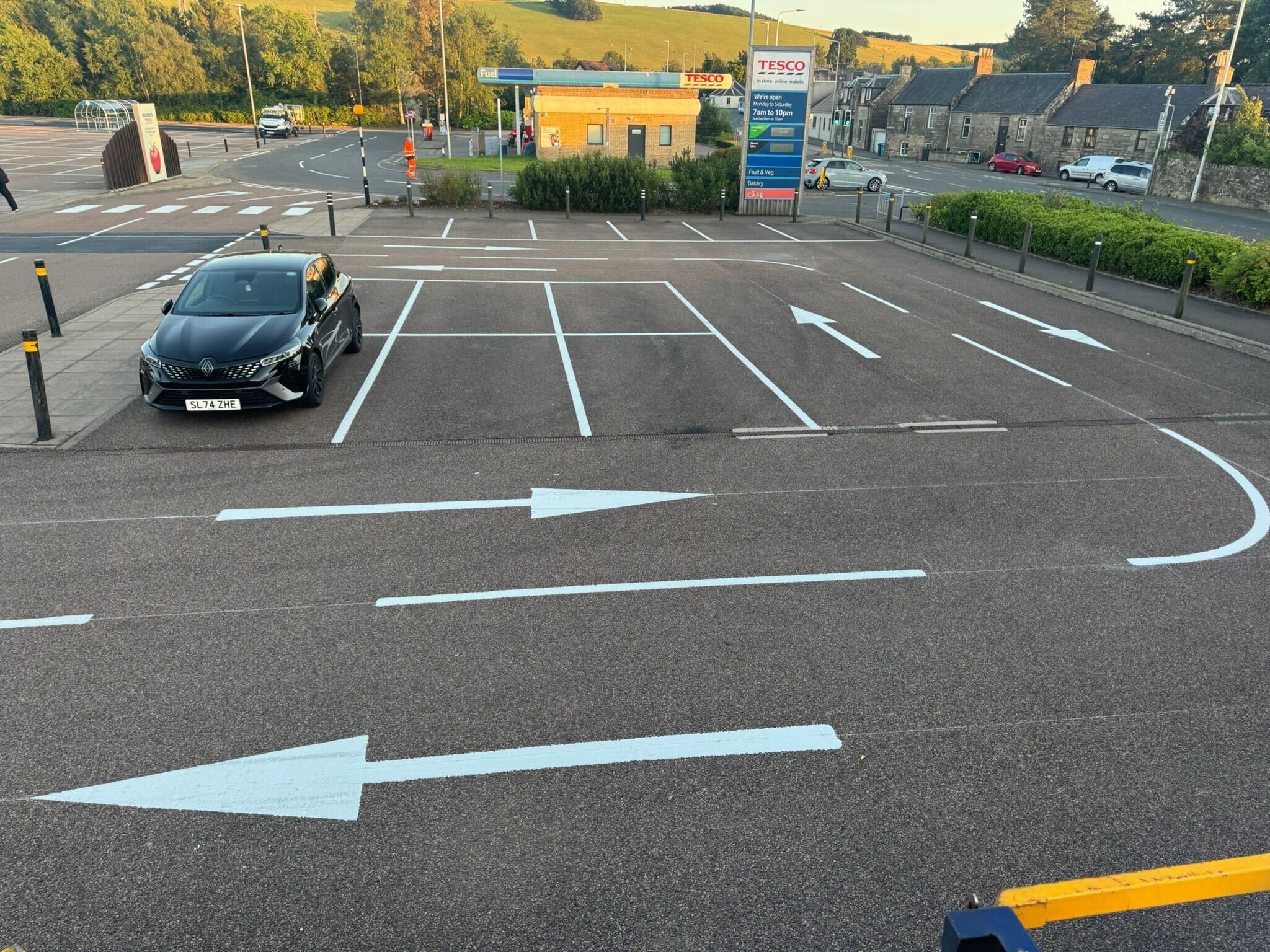
Car parks are full of lines, symbols, arrows and bays — but that often leads to a simple question:
Do car park line markings have to be legal?
It’s something property managers, business owners and site operators ask all the time, especially when refreshing tired markings or redesigning a layout.
The answer isn’t a straight yes or no. It depends on whether the site is on the public highway or private land — and understanding the difference matters more than most people realise.
Public highways vs private car parks.
On the public highway, line markings must follow strict legal requirements set out in the Traffic Signs Regulations and General Directions (TSRGD). Colours, dimensions, symbols and layouts are all defined, and anything outside those rules can be unenforceable.
Private car parks are different.
Most supermarket, retail park, workplace and hospital car parks sit on private land. This means there is more flexibility in how markings are designed and applied.
However, flexibility doesn’t mean anything goes.
Why “best practice” still matters on private sites.
Even where markings aren’t legally prescribed, they still need to make sense to drivers and pedestrians.
Using recognised layouts, colours and symbols helps ensure:
-
Drivers immediately understand the rules of the site
-
Pedestrian routes are clear and predictable
-
Disabled and EV bays are easily identifiable
-
Traffic flows safely without confusion
If markings look unfamiliar or inconsistent, people are far more likely to ignore them — which quickly creates risk.
The role of health and safety responsibilities.
On private land, site operators still have a duty of care.
Clear line marking plays a key role in managing workplace and public safety, particularly where vehicles and pedestrians mix. Poorly planned or unclear markings can contribute to near-misses, accidents, and liability issues.
While the paint itself may not be “law”, the consequences of unclear layouts very much are.
Disabled bays, EV bays and pedestrian routes.
Some areas require extra care.
Disabled bays should be clearly identifiable, sensibly positioned, and sized to allow safe access. EV charging bays need to be obvious enough to prevent misuse and protect charging equipment.
Pedestrian routes should be continuous, visible, and designed around how people actually move through the site — not just how it looks on a drawing.
Why copying old layouts can cause problems.
One of the most common mistakes is simply repainting what’s already there.
Sites change over time. Traffic increases, EV chargers are added, access points move, and usage patterns shift. Refreshing outdated layouts can lock in inefficiencies and risks that no longer make sense.
Remarking is often the ideal moment to review whether the layout still works.
How C&R approaches car park line marking.
At C&R Ltd, we help clients strike the right balance between compliance, best practice and real-world use.
We assess how the site operates, how drivers and pedestrians interact, and where improvements can be made before any paint is applied.
The goal is always the same: clear, intuitive layouts that support safety, efficiency and accessibility — whether the site is legally regulated or not.
Conclusion.
Car park line markings don’t always have to be “legal” in the strictest sense — but they do have to work.
Clear, familiar and well-planned markings reduce confusion, improve safety and help protect those responsible for the site.
If you’re planning to refresh or redesign a car park and aren’t sure what standards apply, C&R Ltd can help you get it right from the start.
Why Choose C&R.
As one of the UK’s leading specialists in line marking, surface preparation, coatings, and cleaning, C&R delivers expert advice, professional results, and long-lasting performance nationwide.
Over 30 Years’ Experience
Trusted nationwide by major brands and local authorities.
Fully Accredited & Insured
Working to UK safety and environmental standards.
Complete Start-to-Finish Service
From design and preparation to marking and aftercare.
Nationwide Coverage
Responsive teams operating across England, Scotland, and Wales.